

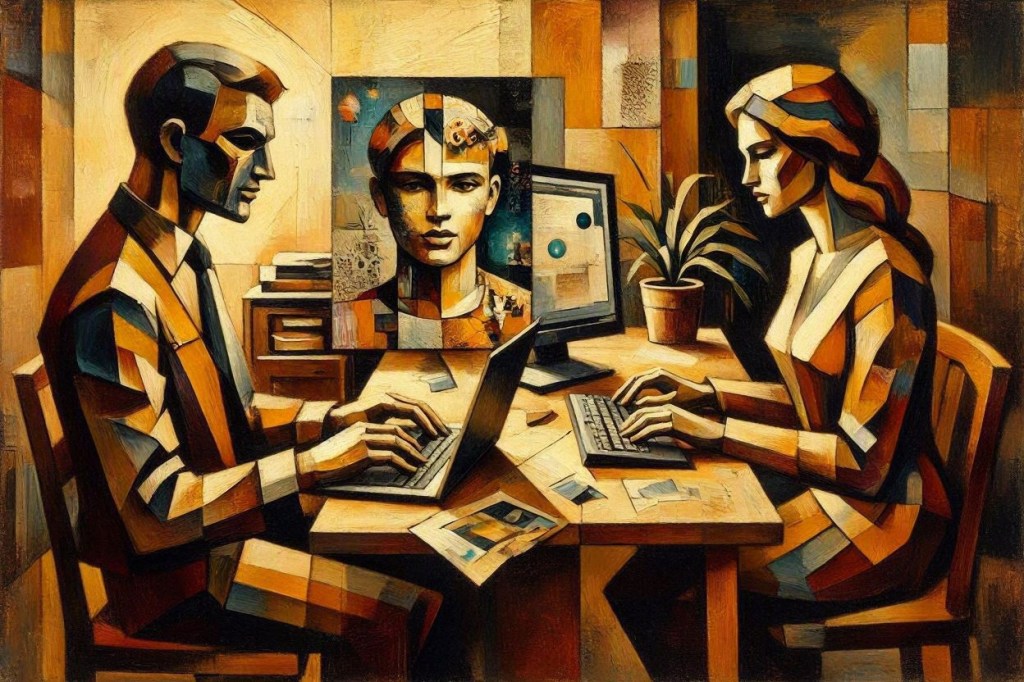
Twice a month, I participate in a virtual writing get-together. We’re presented with three prompts, given thirty minutes to write, and then share what we’ve written.
One woman, who suffered neurological issues after a fall, hasn’t written anything during class for at least a year. Sometimes, she shares what she’s previously written. Last week, she read a lengthy poem she’d supposedly written in thirty minutes. It was twice as long as others had written and felt disjointed.
I asked how she’d written so much in such a short amount of time, and she said, “When the words come, they come.”
I knew she’d used AI to write it because at the start of the gathering, she’d used AI to find an answer to a question posed by a participant. Plus, she didn’t turn off her camera when allegedly writing. Her face was calm as if looking at the screen and not madly banging on a keyboard.
If you’ve watched someone hurriedly write, they look like singer Joe Cocker, brow furrowed, eyes looking side-to-side, and lips contorted in concentration.
Meanwhile, my friend who’s intrigued by online dating, joined a more reputable site. She corresponded with a man for less then a week then received an email from the site, “We are currently investigating suspicious activity associated with an account you interacted with on our platform— [name], 59, from [city]. This account has been flagged for suspicious activity and may have been using a false identity or attempting to defraud members.”
The email told her to immediately cease all contact with the individual.
Jeepers. What’s going on? Is AI making us more dishonest?
My new best friend Copilot explains, Research shows delegating tasks to AI can make people more willing to cheat and more likely to get dishonest results, because AI lowers moral barriers and is more compliant with unethical requests than humans.”
According to a study published by Oxford University, people have been “outsourcing their sins” since antiquity, hiring assassins to kill rivals, mercenaries to fight wars, and foreign labor to do arduous jobs. Outsourcing now extends to AI, making AI the culprit of deceptive practices.
It’s akin to saying “My dog ate my homework.” Except, it was AI, which did the dirty deed.
In a simple dice-rolling game, conducted by German researchers, players weren’t abashed to inputting—into a machine agent—false dice rolls, earning more money or adjusting a dial so the agent prioritized profit over accuracy. They reasoned, the machine was committing the deceit, not them; thereby, diluting the guilt.
An article in Psychology Today cites moral disengagement. “AI doesn’t inherently make people dishonest, but it makes dishonesty easier to request, justify, and execute.” The technology creates a “moral distance,” encouraging people to act in ways they wouldn’t otherwise.
The article elaborates how a person used AI to amplify their resume by revising the content and adding a certification they didn’t earn. A human career coach or friend would probably “draw the line” at blatantly fabricating a resume. AI, on the other hand, doesn’t see the line. Because fabrications were committed by AI, the person feels less responsible for the outcome.
Adding another layer, because AI is used for reviewing and recommending resumes, job seekers are more inclined to tailor their resumes—regardless of accuracy—to match job descriptions and hopefully get an interview. It’s a circle of deception driven by the desperation to end disheartening unemployment coupled with the challenge of dealing with a tsunami of resumes for a single job.
Is there an answer?
In 1989, performers Milli Vanilli were chastised for lip-syncing to songs they didn’t sing. Their manager convinced them to continue the deception despite their growing concerns. Today’s deceptions are infinitely more destructive; the waves of dishonesty spreading across institutions and harming individuals.


Leave a Reply