
Recently, I wrote a blog post for Bridge Partners Consulting about Worker 4.0. I tried to paint a rosy picture, reading megabytes of articles to find a few morsels of optimism about the future of employment. Most projections, however, point to fewer jobs with traditional, labor-intensive, middle-class manufacturing jobs being automated or outsourced with few, high-paying jobs evolving to absorb people without advanced degrees.
The concept of having a career – an undertaking that comprises a significant period of one’s life with opportunities for progressing – is being replaced by short stints at various companies or becoming a part of the gig economy, characterized by short-term contracts or freelance work.
Then I went on vacation to San Juan Island.
Back-to-basics
Riding on the back of my husband’s Harley, I contemplated the work places of tomorrow. On the second day, we visited English Camp, a military stronghold, established in 1859 to protect Britain’s claim to the island.* To help visitors visualize life in the camp, the park rangers dress in period clothing and demonstrate traditional crafts and activities, such as loading and firing a musket, washing clothes with lye soap, crafting roof shingles and wooden barrels, and forging steel tools and utensils.
I spent at least 30 minutes conversing with the blacksmith who was helping a “pretend” British soldier shape a coat hook using a hammer, anvil, tongs, and a three-quarter sized traveling forge, built from plans archived at the Smithsonian. Formerly a history teacher, the blacksmith shared that ten years ago, there was barely half a dozen blacksmiths in every state. Today, there are thousands across the country. Most as he pointed out, are amateurs, but skilled enough to produce hand wrought items for sale at craft shows, farmers markets and over the Internet.
I recalled that last year, my cousin sent me a hand forged garden rake from Fisher Blacksmithing. The tool is indestructible. Weeds cringe when they see me approach, knowing I’m equipped to yank out the most obstinate and thorny garden-intruders.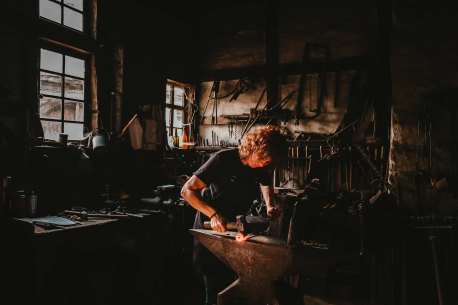
With a background as a farrier, and having made his own farrier tools, Tuli Fisher of Fisher Blacksmithing realized there was a market for hand-made tools for woodworkers, timber framers, stonemasons, and gardeners. Today, his tools are sold around the world, and lauded by Forbes Life, Garden Design, Sunset, and a wealth of other publications.
While industrial and factory jobs might be disappearing, a plethora of people are turning to centuries-old skills, using their hands and tools to craft, weave, forge, paint, sketch, bake, preserve, and sew their way into new, more fulfilling careers.
The blossoming of Esty, popularity of Pinterest, success of eBay, Amazon, and other ecommerce sites, and support for local craft and farmers markets is a testament to the demand for hand-crafted, often one-of-a-kind products.
Extending this return to the “basics” is people considering how they can monetize their assets from turning infrequently used rooms into short-term housing (Airbnb, VRBO) to earning money from the rental or sharing of their vehicles (Uber, Lyft, GetAround), bikes (BikeShare), clothing (Rent the Runway, Tradesy), services (Shareable, TaskRabbit), and dozens of other opportunities.
Enterprises are also exploring how to generate revenue from what they own or skirting purchasing equipment that can be rented. Sites like EquipmentShare make it possible to both rent and offer for lease heavy construction equipment.
Farmlink, Washington Farmlink, and Maine Farmlink connects those looking to rent, lease or buy farm land, often from retiring farmers. LocalHarvest enables farmers to sell “shares” of their crops directly to consumers in the form of weekly boxes of local, seasonally grown produce, dried beans, and flowers.
These endeavors are driving the shared or collaborative economy, dominated by peer-to-peer exchanges. While most participants aren’t getting rich, they’re able to generate revenue that otherwise wouldn’t be possible if they weren’t putting their unused or underused assets and resources to work.
According to Pew Research and Nielsen, 72 percent of Americans have used one or more shared economy services, and two in three consumers are willing to share and/or rent their personal assets.[1] In addition, 70 percent of American consumers view convenience as the primary reason for utilizing products and services in the shared economy with 60 percent citing price and 40 percent service quality and/or unique products.[2]
During our stay on San Juan Island, my husband and I chose to stay in a bed-and-breakfast (BnB) because of the price and experience. We met people from New York, Maryland, Texas, and parts of Washington. Most of the lodgers talked late into the evening, continuing their conversations the next morning at breakfast. After spending time at the BnB, we booked Airbnbs for our upcoming vacation, something we wouldn’t have considered a year ago.
Transformation-through-technology
Along with the usual assortment of vehicles and motorcycles crisscrossing San Juan Island was funky-three wheeled, Italian-made Scoot Coupes and groups of bicyclists. Some of the bicycles had sturdy-frames and fat-tires and were traveling unusually fast. It occurred to me they were electric bikes. Rented from Susie’s Mopeds, the bikes came from Pedego, a California company that makes a range of electric bikes, which take the “sweat” out of pedaling up steep hills or traveling long distances. The 48-volt batteries in the bikes use the same advanced lithium-ion cells as in cars and can power a bike at 20 miles per hour for nearly 60 miles on a charge.
The declining price, reliability and safety of lithium-ion batteries, coupled with their increased availability is fueling the development of cars, bikes, boats, consumer electronics, storage for solar panels, remote monitoring systems, and much more. In some cases, lithium-ion batteries are being used in place of legacy batteries. More often, they’re powering evolving products and uses.
Similarly, drone technology is propagating new uses that weren’t conceivable just a few years ago. In 2015, when the Federal Aviation Administration (FAA) granted hundreds of exemptions to US companies who wanted to operate drones, the market seemingly doubled overnight, reaching $4.5 billion in revenue a year later.[3] By 2021, the sale of drones is expected to surpass $12 billion.[4]
 Companies are now using drones for inspecting and surveying utilities (power lines, wind turbines, pipelines, etc.) farms and vineyards, forests and public lands, and building infrastructures. These activities have generated tens of thousands of jobs, including commercial drone operators. The use of the cloud for storing, tagging, analyzing, and sharing drone images and streaming video, removed much of the drudgery and complexity of operating drones, making it possible for someone with ambition, but not necessarily technical expertise to enter the field.
In recent years, the use of artificial intelligence (AI) has elevated drones from data collection to automating the detection of specific issues, anomalies, trends, and patterns. In the UK and India, a project is underway to use drones to identify violent behavior in crowds by using AI algorithms that detect postures that could be deemed violent.[5]
In early 2017, I was introduced to Optelos who had developed a cloud-based platform for applying machine learning to automate drone footage analytics. At the time, I was writing collateral for a video production company in Everett, WA. One of their clients was Optelos. I was floored by the sophistication and foresight of their platform. I told the owner of the video company that Optelos – at the time a 2 or 3-person company — was going to be very successful. He thought I was exaggerating their potential.
Less than two years later, Optelos is a leader in drone analytics. Their success illustrates an approaching tsunami of innovations that doesn’t necessarily require an advanced degree to leverage the incredible complexity, yet transformative power of cloud computing, big data, AI, robotics, 3D printing, Internet of Things/Industrial Internet of Things (IoT/IIoT), and many more emerging technologies.
It’s becoming clear, having some technical proficiency may suffice with companies releasing breakthrough solutions that are akin to plug-and-play, envisioned, simplified and verified by multitudes of PhD’s who’ve done the “heavy lifting.” Developers of these solutions are realizing beating the competition requires minimizing the complexity of implementing their solutions. They’re touting how easy it is for customers to augment their existing infrastructures, rather than start from scratch.
Most of these solutions harness IoT/IIoT, enabling companies, municipalities, utilities, farms, and other enterprises to use sensors to capture data that can be analyzed and visualized to provide transformative insights. The relative simplicity of adding sensors has the potential to refresh older products, generating revenue opportunities and new jobs.
Even the most mundane products can be transformed. The humble childhood toy, the Hula Hoop is being morphed by VIRFIT into a sophisticated, personal fitness device with the addition of IoT sensors, weights and a slick mobile app.
American writer Washington Irving wrote that change is “To shift one’s position and be bruised in a new place.” It fits the changes taking place in the workplace where people are having to redefine how they work, and what constitutes meaningful work. For some, it means going back to the basics. For most, it’s riding the wave of today’s and tomorrow’s emerging technologies.
Want to read more? Visit scribbles and check out other articles I’ve written about technology, transformation, and “marketing from the grocery aisles.”
* In 1859, there was a dispute over ownership of the island, which was precipitated when an American shot a pig owned by the British Hudson’s Bay Company by an American. The easily forgotten Pig War broke-out, which amounted to British and American militia setting up separate camps at either ends of the island, and “hanging out” for 14 years until the border dispute could be remedied.
 scribbles