
Last weekend, I attended a neighborhood party, where the conversation devolved to local grocery stores. Living on an island with a population of less than 60,000 people with 22,306 at the Whidbey Island Naval Station, 23,204 in Oak Harbor, the island’s largest town, and the remaining 12,700 scattered across the island, there aren’t a lot for options for shopping.
Fortunately, Oak Harbor has three grocery stores. Two belong to a large chain, and the third is one of eight stores in Washington. There’s also a small selection of foods at the Walmart, and people who live on the base can shop at the Army Exchange.
The conversation about grocery stores centered on quality and variety of meats, produce, prepared meals, and hard-to-find items. Most of the people at the party, shop at the most expensive and upscale grocery store because of its selection of meats, and their floral department.
I forgot about the conversation until this morning when I read an article about Kroger rolling out Kroger Edge, digital store shelves, which display pricing and nutritional information, as well as video ads and coupons. The largest supermarket chain by revenue in the United States, Kroger believes this technology will not only provide their customers with more detailed information about products, but enables them to instantly change prices and activate promotions across a store, with a few mouse clicks. 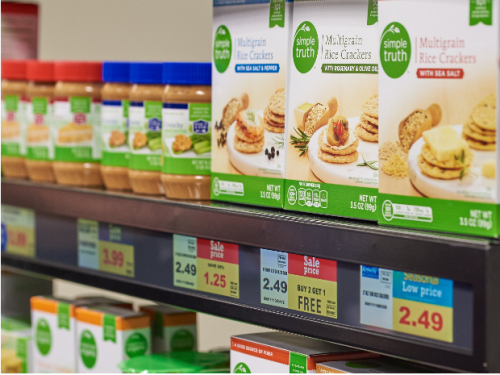
Imagine walking down the canned soup aisle and getting an alert on your phone, indicating a sale on Campbell Soups, along with a coupon for 50¢ off. Or while you’re in the soup aisle, a light blinks beneath the boxes of macaroni and cheese, which are next on your shopping list. Perhaps you’re on a gluten free diet. The digital signage on the shelves can alert you to foods, which contain gluten.
Hoping to change the way consumers grocery shop, Kroger is installing Kroger Edge in nearly 200 stores by the end of 2018. While their vision aligns with friction-free interactions between humans, technology, and things, I can’t help wondering, “Is it necessary?”
In 2017, Kroger expanded its ClickList an online order and customer pickup service. Customers select items online or via an app, and choose a time window for pick-up. When they arrive at the store, they park in a ClickList-identified spot, and then phone the store, sharing where they’re parked. A few minutes later, their groceries are wheeled out to their car.
The service makes sense for busy parents and workers who don’t have the time to shop or prefer to spend their time doing something other than grocery shopping. To make ClickList even more convenient, Kroger is starting home delivery.
If the premise is people don’t have time to shop then it might be counterproductive to expect people to create on-line shopping lists so when they meander down the aisles, they’re pinged to buy the items on their list or prompted to check-out a “deal” that just popped up on a display in the aisle.
Although, my engineer husband recently made a comment while shopping at Fred Meyer, a Kroger store, that an app, indicating what needs to be “picked” in each aisle would make it easier and faster for employees to fill ClickList orders.
Going back to last weekend’s debate about the best grocery store in Oak Harbor. My neighbors’ loyalty seems to hinge on having the products they want, at a “reasonable” price, fast check-out, and a clean, brightly lit store.
Unlike my neighbors, I choose to shop at the slightly skanky, out-of-date, Washington-based grocery store, which caters to the people at the Naval base who hail from around the United States and other countries. The inconvenience of having to present my “paper” coupons before the checker enters my purchases pales when it comes to their extraordinary selection of produce, and items that aren’t stocked in other stores, such as fresh okra, poblano peppers, tomatillos, Thai and Japanese eggplants, long beans… aisles of Oriental and Hispanic packaged and canned goods… and freezer cases of every imaginable fish and seafood along with prepared foods, such as rice in tea leaves, mochi, fish cakes, steamed buns, and much more.
Thanks to ja ma for the photo on Unsplash
 scribbles